






Abstract and push-your-luck blend together in this dice game about racing to get five in a row.
Published by Freonix Games, Quanta 5 is a 2-4 player game (when playing with teams) with a 15-minute playtime.
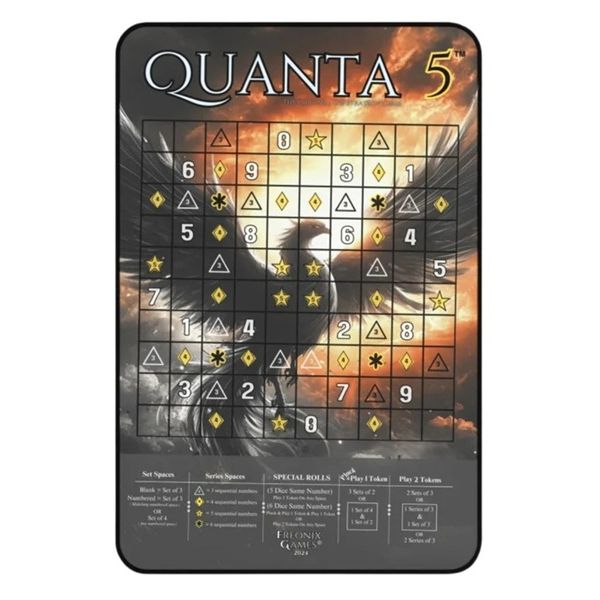
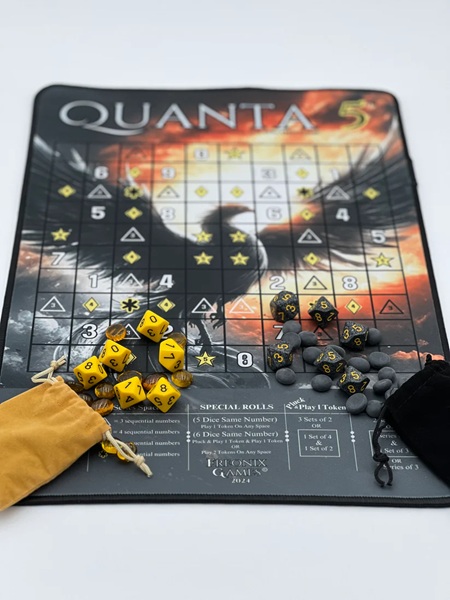
The game mat shows a grid of spaces, some blank, some with numbers on them, some with numbers inside specific shapes. Both players take six 10-sided dice and 30 gemstones in their player color.
On a player’s turn, he rolls his six dice. He can reroll up to three times. He then uses his result to place a gem on the board.
Sets of the same three numbers allow a gemstone to be placed on a blank space or on a space with the rolled number. A series of consecutive numbers allows it to be placed on a space with a number inside a shape, with the number of dice inside that shape determined by how many consecutive numbers were rolled. The goal of the game is to create a line of five gemstones in your player color, arranged either horizontally, vertically, or diagonally. The winner is the first to create two of these lines.
There are also a number of special rolls players can achieve. For example, three sets of two allow a player to replace any one of his opponent’s gemstones that is not already part of a line of five, with one of his own.
Blending push-your-luck with the winning mechanic of getting five in a row is a clever combination that leads to some very satisfying gameplay. There’s a strategic element to what players decide to work towards on their dice rolls, while luck can lead to surprising board placements that evolve a player’s plan.
It’s also an attractive game, with nice, solid gemstones, attractive dice that are fun to roll, and a fun fantasy image for the player mat. It’s packed in a tube, which might be a little clunky for storing (and it is a bit annoying to repack), but it does all look satisfying.
The different types of rolls you can work towards also lead to a lot of choice for the player. Even though there’s a lot of luck with the dice-rolling, you still feel like you have input in how the game plays out.
There are a surprising number of rules you have to learn, as there are a lot of special rolls or little rules addenda to the specific rolls. There are player aid cards, and information is also printed on the play mat, but this still doesn't cover everything you have to know. We spent a lot of time early on looking back at the rules.
The rules are also not great. They only have one example image and also leave at least one important rule point unclear — it never explicitly states whether you can set aside dice between rerolls. Given how most dice games work, we assumed we were probably allowed to do so, but it doesn't actually explicitly state that you can. We were also left with questions about how some of the special rolls worked. Finally, the rulebook talks about playing with 3-4 players without teams, but the game doesn't include the components to support this.
All of these issues aside, we still had a fun time with the game, enjoying the mixture of mechanics. The execution issues in the rules are unfortunate, but there are some great ideas here that result in an enjoyable game.
Pros: Nice balance of luck and player choice, looks attractive
Cons: Rules leave some important points ambiguous, a lot of consulting the rulebook when you first start playing
Disclosure: we received a complimentary review copy of this game.