






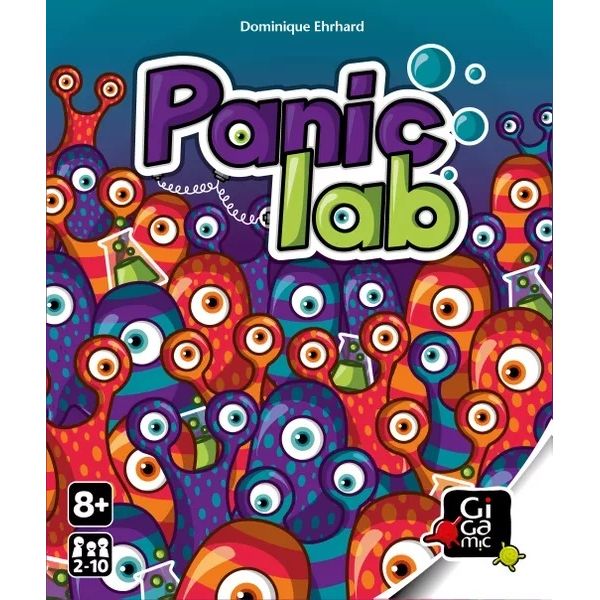
The amoebas are escaping from the lab! Race to be the first to find them, but watch out for vents and unexpected mutations.
Published by Gigamic and Hachette Boardgames USA, Panic Lab is a 30-minute game designed for 2-10 people, with real-time elements.
The tiles are shuffled and placed in a ring in the center of the table. Each round, the dice are rolled. The dice determine one of two colors, one of two patterns, and one of two shapes. The resulting combination determines which amoeba the players are searching for. Most of the tiles show amoebas, but there are also three different lab tiles. The fourth die rolled shows which lab the amoeba escaped from and in which direction it went around the ring. Players are trying to find the correct amoeba that is closest to the lab it escaped from, when going in the correct direction around the ring.
There are also vent tiles and mutation tiles. If, while searching in the correct direction, there is no amoeba between the lab and a vent tile, the amoeba has ‘gone into the vent,' and players skip to the next vent and search from that point. If the path the amoeba took would have taken it through a mutation lab, it gets mutated. One mutation tile changes the amoeba’s color, one it’s pattern, and one it’s shape.
The first player to find the correct amoeba, taking into account vents and mutations, takes a victory counter. The dice are then rolled again for the next round. The first player to five victory counters wins the game.
If a player chooses an amoeba tile, believing it to be the correct one, but players confirm that it was not, that player loses a victory counter if he has one.
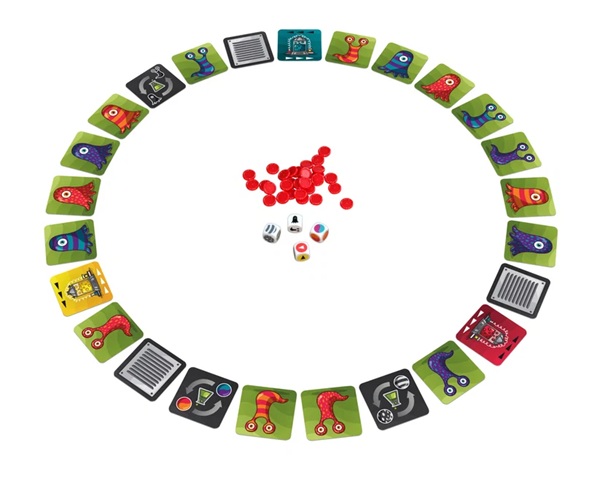
At first glance Panic Lab appears fairly simple. You roll the dice and race to be the first to find the combination. There aren’t even many combinations, since there are only two versions of each physical trait. However, once you start adding in the vents and the mutations, as well as the real-time pressure, the game gets surprisingly challenging.
There’s luck involved in determining how tricky each round is going to be. Which combination the dice rolls together with how the tiles end up getting dealt out means that sometimes you have an easy hunt and sometimes an amoeba can slither through multiple vents or mutation tiles.
The tiles themselves are pretty slim, but the artwork is colorful and bright. It’s generally a fun, family-friendly game, although not one that can really be played satisfyingly with adults and children at the same time. There are suggested rules for making the game simpler for children, and while children can definitely enjoy this game, the skill difference is likely to be an issue if adults and younger children are playing together.
We would recommend adjusting the end-game trigger based on player count. At the higher player counts, if you were playing until one person had five victories, it would almost certainly overstay it’s welcome.
This was a fun, enjoyable game that makes you think. It’s fast and trickier than we expected. It’s a nice, light game that has more to offer than you’d expect on first glance.
Pros: Vents and mutations add a nice level of challenge, not all rounds are equally difficult, colorful artwork
Cons: May need to adjust how many rounds you play, tiles are thin, adults would likely have a significant advantage if playing in a family setting
Disclosure: we received a complimentary review copy of this game.